

Written by Oliver Freedman, Roamwild USA. Published September 16, 2026. Prices checked September 2026. We make the PestOff feeder, so read our conclusions with that in mind; the facts and sources are given so you can check them.
Short answer: the squirrel proof feeders that actually work all rely on one of four ideas: a weight-activated mechanism that closes the ports, a cage sized for small birds, a motorized perch, or a baffle on the pole. Which one is best depends on how many birds you want feeding at once, whether you are willing to adjust a spring, and how much you want to spend. Weight-activated tube feeders are the most popular category, and the choice inside it comes down to one spring for all the ports or one spring per port.
How squirrel proof feeders work
An eastern gray squirrel weighs 14 to 21 oz. A northern cardinal weighs 1.5 to 1.7 oz and a black-capped chickadee well under half an ounce. Every effective squirrel proof design exploits that gap in one of four ways:
- Weight-activated ports. A perch or shroud drops under a squirrel's weight and covers the seed ports; it lifts again for birds. Two sub-types matter: single-spring designs, where one spring controls every port and closes them all together, and per-port designs, where each port has its own spring so only the loaded port closes.
- Caged feeders. A wire cage with openings around 1.5 inches lets small birds in and keeps squirrels and larger birds out. Cardinals, at 8 to 9 inches long, often cannot get through.
- Motorized perches. A battery-driven perch spins when a squirrel's weight lands on it.
- Baffles and placement. A pole baffle 4 to 5 feet up, with the feeder 8 to 10 feet from any launch point, stops squirrels reaching an ordinary feeder at all.
The comparison
| Feeder type | Mechanism | Ports | Capacity | Adjustment | Weather guard | Price (Sept 2026) |
|---|---|---|---|---|---|---|
| Roamwild PestOff 2.0 | Weight-activated; each port on its own spring | 2 | 4 lb | None, factory-set | Built in | $49.99 to $54.99, free US shipping |
| Single-spring weight-activated tube feeders | Weight-activated; one spring closes all ports | Up to 6 | About 5 lb | Adjustable spring tension | Usually sold separately | Typically $100 or more |
| Roamwild Mega PestOff | Same per-port springs as the 2.0 | 2 | 8 lb | None | Built in | $79.99, free US shipping |
| Motorized-perch feeders | Perch spins under a squirrel's weight | About 4 | Varies | Rechargeable battery | None | Typically $150 or more |
| Caged tube feeders | Wire cage around a tube | Varies | Varies | None | Varies | From about $30 |
Single-spring weight-activated feeders
These are the feeders most roundups name first, and for good reason: up to six feeding ports, around 5 lb of capacity and a weight-adjustable spring that lets you tune which birds can feed. The trade-offs are the ones BWD Magazine described in its 2019 test: all the ports hang on one spring, so when a squirrel lands every port closes and every bird loses its place; the spring needs setting and occasional readjustment; the weather guard is usually a separate purchase; and the leading models cost roughly two to two and a half times the PestOff 2.0.
Roamwild PestOff 2.0
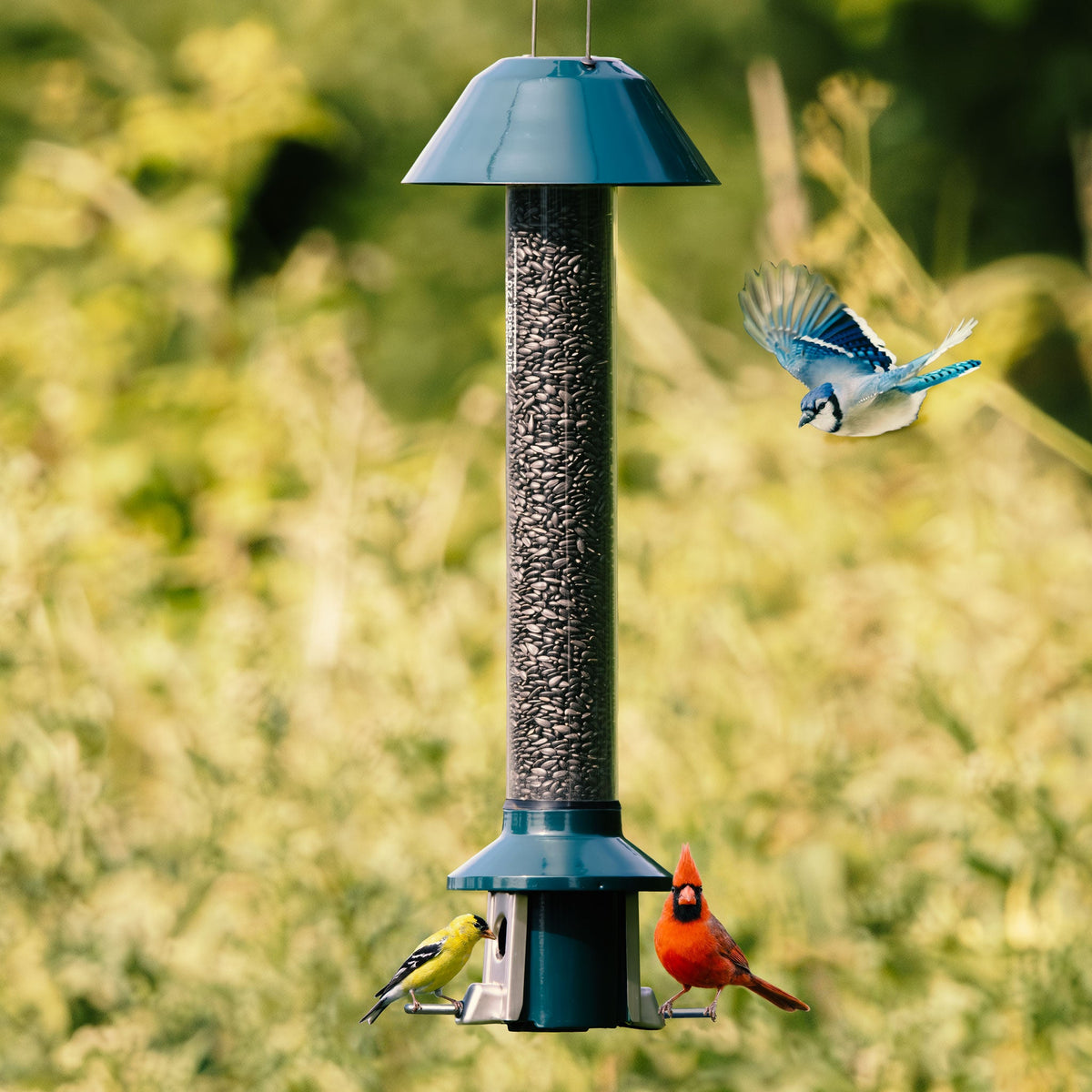
The PestOff 2.0 takes the opposite approach on ports. Each of its two ports has its own spring, so a squirrel on one perch closes only that port and the bird on the other keeps eating; there is nothing to calibrate. It holds 4 lb of seed, has dual metal baffles, an anti-squirrel ring and a built-in rain guard, and comes in seven finishes at $49.99 to $54.99 with free US shipping. The honest trade-off is capacity for birds: two feed at a time, not six. On this site it is rated 4.2 out of 5 across 53 verified reviews, and the most common complaint in the lower ratings is exactly that port count. Woman's Day listed it among 12 feeders that thwart squirrels in August 2024.
Motorized and caged designs
Motorized feeders spin a squirrel off the perch. They work, and they are entertaining, but they need a rechargeable battery and offer no weather protection. Caged feeders are the cheapest reliable option and are excellent for finches and chickadees; the catch is that cardinals, red-bellied woodpeckers and other birds you may want most are too big for the cage.
Which should you buy?
- Busy yard, you like to tinker, budget is not the issue: a single-spring feeder with adjustable tension.
- Want it to work out of the box, prefer that one squirrel does not shut out every bird, under $60: PestOff 2.0. Add a second feeder or the 8 lb Mega if you need more birds feeding at once.
- Finches and chickadees only: a caged feeder.
- Any feeder at all: hang it 18 inches from any vertical surface and 5 feet off the ground, or put it on a baffled pole 8 to 10 feet from anything a squirrel can jump from. Placement beats mechanism every time.
Frequently asked questions
Is any bird feeder 100% squirrel proof?
Only when it is placed correctly. A weight-activated feeder hung within 18 inches of a fence lets a squirrel reach the ports without ever touching a perch. Every manufacturer's guarantee, including Roamwild's PestOff Promise, assumes the placement rules are followed.
Do weight-activated feeders shut out cardinals?
Not when set for songbirds. BWD Magazine's test found the PestOff admits cardinals and red-bellied woodpeckers while excluding grackles, mourning doves and squirrels. Adjustable single-spring feeders can be set to admit or exclude heavier birds.
Single spring or per-port spring: which is better?
Per-port springs keep other birds feeding while one port is closed and need no adjustment; single-spring feeders offer more ports and let you tune the trigger weight. Both stop squirrels.
Sources
- Dawn Hewitt, "The Well-Equipped Birder: Squirrel-Proof Feeders," BWD Magazine, Nov/Dec 2019.
- Maggie Panos, "12 Bird Feeders That Will Thwart Even the Craftiest Squirrels," Woman's Day, August 23, 2024.
- Bird weights: Cornell Lab of Ornithology, All About Birds.


